John Rawls
Lesekreis
Video
Please note that this video is available in German.
The video presents an introduction to the basic ideas of Rawls’ theory of justice, taking up important concepts such as equality as well as Rawl’s central concept of the primordial state.
The following text is discussed in the video clip:
John Rawls, Eine Theorie der Gerechtigkeit
Kapitel 1, Gerechtigkeit als Fairness (Suhrkamp Taschenbuch Wissenschaft, 22. Auflage 2020, S. 19 – 39).
John Rawls (*1921 Baltimore, †2002) was an American philosopher and professor at Harvard University and is considered a central as well as much-discussed representative of 20th century political philosophy. In his major work, A Theory of Justice (1971), he developed a standpoint of social equality from which members of a society are supposed to agree on certain principles of justice. In his approach, socially disadvantaged groups, as well as questions of the distribution of material resources and education, play a decisive role. At the same time, he represents a liberal self-image in which the freedom of the individual within democracy is a high good. Despite his efforts to achieve social and political justice, Rawls’ theory has been increasingly appropriated by neoliberal discourses and used as legitimation for an accentuated economic liberalism.
More contributions
Performance Total Romance: Partial Repair
Isabel Lewis, Dirk Bell with vocalist, performer and artist Rupert Enticknap and performer and pole dancer Yann Slattery
Video


The performance Total Romance: Partial Repair is the centerpiece of Isabel Lewis and Dirk Bell’s joint exhibition Ever/Repair at HALLE FÜR KUNST Steiermark, and is performed by four performers. In…
Performance Total Romance: Partial Repair Isabel Lewis, Dirk Bell with vocalist, performer and artist Rupert Enticknap and performer and pole dancer Yann Slattery Isabel Lewis, Dirk Bell
Total Romance: Partial Repair
Performance
Slide show


The performance Total Romance: Partial Repair is the centerpiece of Isabel Lewis and Dirk Bell’s joint exhibition Ever/Repair at HALLE FÜR KUNST Steiermark, and will be performed by four performers.
Total Romance: Partial Repair Artist talk with
Thomas D. Trummer and Franz Kapfer
Video


Thomas Trummer and Franz Kapfer have known each other for many years and have collaborated on various occasions. Over the years, a number of exhibitions and published interviews as well as…
Artist talk with Thomas D. Trummer and Franz KapferThe Uncanny within Visual Arts — August Ruhs
Video


Color is both the starting point and the end point for Katherine Bradford, used to depict both diverse communities and the individuals who constitute them. Interweaving abstraction with figuration…
The Uncanny within Visual Arts - August Ruhs Exhibition Tour
Katherine Bradford: American Odyssey
Video


A comprehensive video by kunst-dokumentation.com enables a digital exhibition tour through the show.
exhibition tour katherine bradford Definite or indefinite or…? Debates on gender in art and politics
Silvia Stoller
Video


Katherine Bradford’s painting can be located in the tradition of abstract expressionism, particularly in colour field painting. During her very personal American Odyssey, she developed her very own style: interweaving abstraction and the figurative she creates very special bodies. The bodies’ faces often lack facial expressions.
Silvia Stoller Collective Memory and the Public Realm in the United States
Nassim W. Balestrini
Video


Drawing on examples of US-American monuments, Prof. Dr. Nassim W. Ballestrini’s lecture will discuss collective memory in terms of contemporary debates in the US. Monuments, memorials as well as art in public space contribute significantly to a nation’s culture of remembrance, reflecting political currents and are therefore highly political.
Balestrini Katherine Bradford – American Odyssey
New works
Slide show

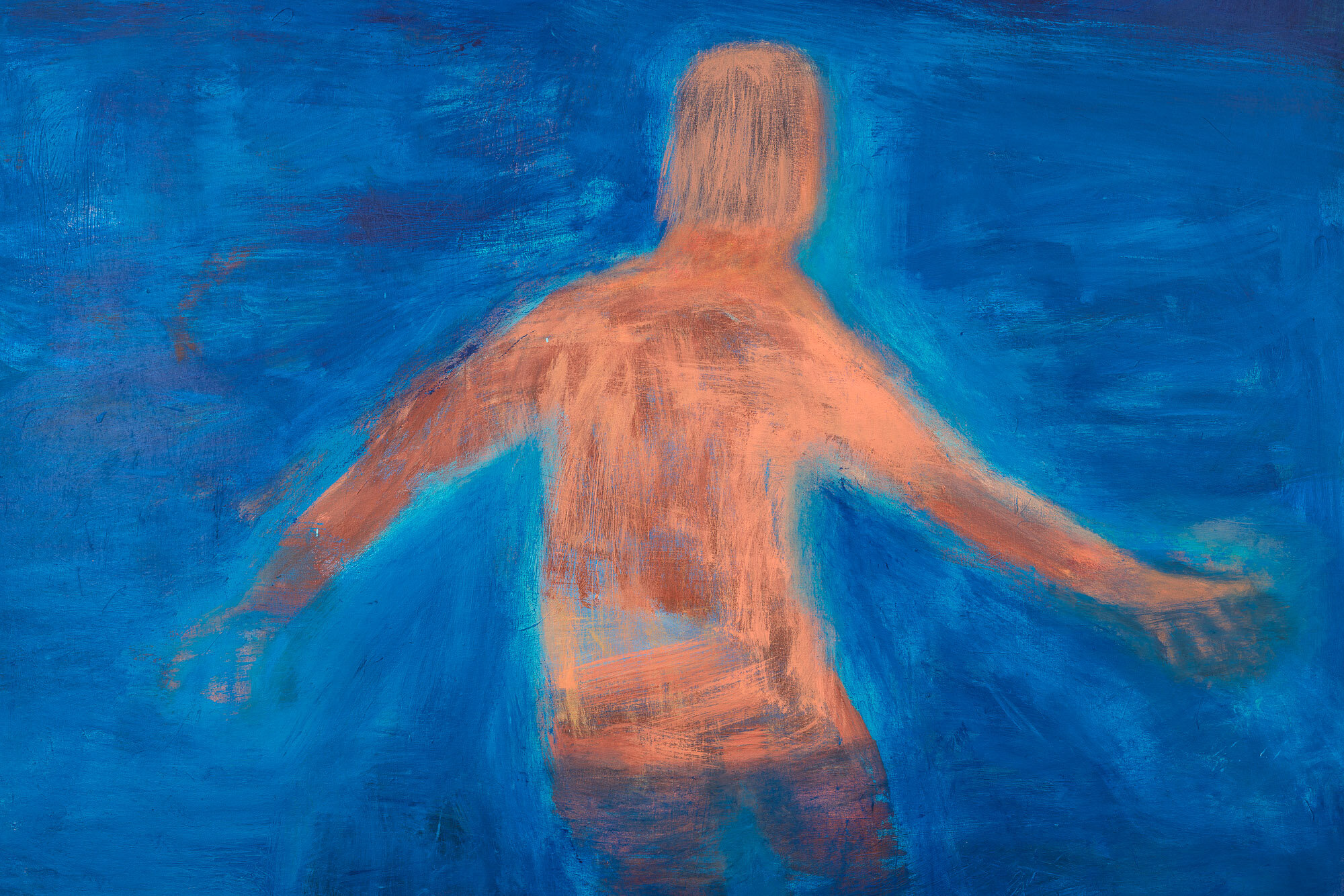
Katherine Bradford’s thinking always begins with color — it is the start and end point of her work. Here abstract and figurative approaches merge. Here the individual and the communal join. This is the…
Katherine Bradford – American Odyssey: New works